
VOCA PMT Reporting: A Practical Quarterly Guide for Victim Service Providers
What VOCA subgrantees report in OVC's Performance Measurement Tool each quarter, the counting mistakes that trigger corrections, and a workflow that keeps the numbers ready before the deadline.
Key takeaways
- VOCA victim assistance subgrantees report performance data to the Office for Victims of Crime through the Performance Measurement Tool (PMT) every quarter of the federal fiscal year.
- Most PMT corrections come from counting problems: mixing up individuals and services, double-counting people across quarters, and treating 'not asked' as 'not reported'.
- Logging each service against the right VOCA category at the time it is delivered is far more reliable than reconstructing a quarter from case notes.
- A pre-submission validation pass — totals that reconcile, demographics that add up, no blank required fields — prevents most rejections from the state administering agency.
On this page
- What the PMT asks VOCA subgrantees to report
- The five VOCA service categories
- What causes most VOCA PMT corrections?
- 1. Mixing up individuals and services
- 2. Counting "new" people twice in a year
- 3. Turning "not asked" into a guess
- 4. Victimization totals that don't reconcile
- How should an agency prepare its quarterly PMT report?
- How NECX VS360 handles VOCA PMT
- Further reading
VOCA PMT reporting is the quarterly data submission every Victims of Crime Act (VOCA) victim assistance subgrantee makes to the Office for Victims of Crime (OVC) through its Performance Measurement Tool. Done well, it takes an afternoon. Done from spreadsheets and memory, it eats the last week of every quarter.
This guide covers what you report, the counting rules that trip agencies up, and a repeatable workflow. It assumes you already know the basics of your award. If any acronym is unfamiliar, see the glossary.
What the PMT asks VOCA subgrantees to report
PMT data describes who you served and what you did for them during the quarter. While your state administering agency (SAA) may add its own questions, the core sections are consistent:
| Section | What it captures |
|---|---|
| Individuals served | Unique people who received VOCA-funded services this quarter, plus how many are new this federal fiscal year |
| Demographics | Race/ethnicity, gender identity and age of the individuals served |
| Victimization types | The types of victimization those individuals presented with (one person can have several) |
| Direct services | Services delivered, grouped by VOCA service category |
| Annual / narrative questions | Program context, challenges and outcomes (frequency set by OVC and your SAA) |
The five VOCA service categories
Every VOCA-funded service you log should map to one of these areas:
- Information and referral — information about the justice process, victim rights and referrals to other services.
- Personal advocacy and accompaniment — advocacy with agencies, employers and landlords, plus accompaniment to medical or legal appointments.
- Emotional support or safety services — crisis intervention, hotline counseling, safety planning and support groups.
- Shelter and housing services — emergency shelter, transitional housing and relocation assistance.
- Criminal or civil justice system assistance — court accompaniment, notification, protection orders and victim impact statements.
The cleanest reports come from agencies that tag the category when the service happens, not at quarter end.
What causes most VOCA PMT corrections?
1. Mixing up individuals and services
One survivor who receives safety planning, court accompaniment and a shelter stay is one individual and three services. Agencies that count case records rather than people inflate "individuals served". This happens most often when one person has several cases or services open.
2. Counting "new" people twice in a year
"New individuals" resets on October 1, at the start of the federal fiscal year, not at each quarter. If a survivor first came to you in Q1 and returns in Q3, they count as served in Q3 but not as new. Spreadsheet tracking rarely gets this right without a stable client ID.
3. Turning "not asked" into a guess
Demographic fields must reflect what the survivor actually shared. If intake didn't ask, or the survivor declined, use the not-reported or not-tracked option. Never infer.
4. Victimization totals that don't reconcile
One person can present with several victimization types, so the victimization totals can exceed the individuals count. They should never be lower than the number of individuals with a recorded victimization. Reviewers check this.
How should an agency prepare its quarterly PMT report?
During the quarter:
- Give every person one client record that lasts across services and years. This is what makes "new this fiscal year" reliable.
- Log each VOCA-funded service against its category and the funding source on the day it is delivered.
- Capture demographics at intake with an explicit "declined" option.
Two weeks before the deadline:
- Run a preview of the quarter's numbers and compare them with last quarter. A large swing usually means a data-entry gap, not a real change.
- Run validation checks: required fields complete, demographic totals equal individuals served, and victimization totals consistent.
- Fix issues in the source records, not in the report, so next quarter starts clean.
Submission week:
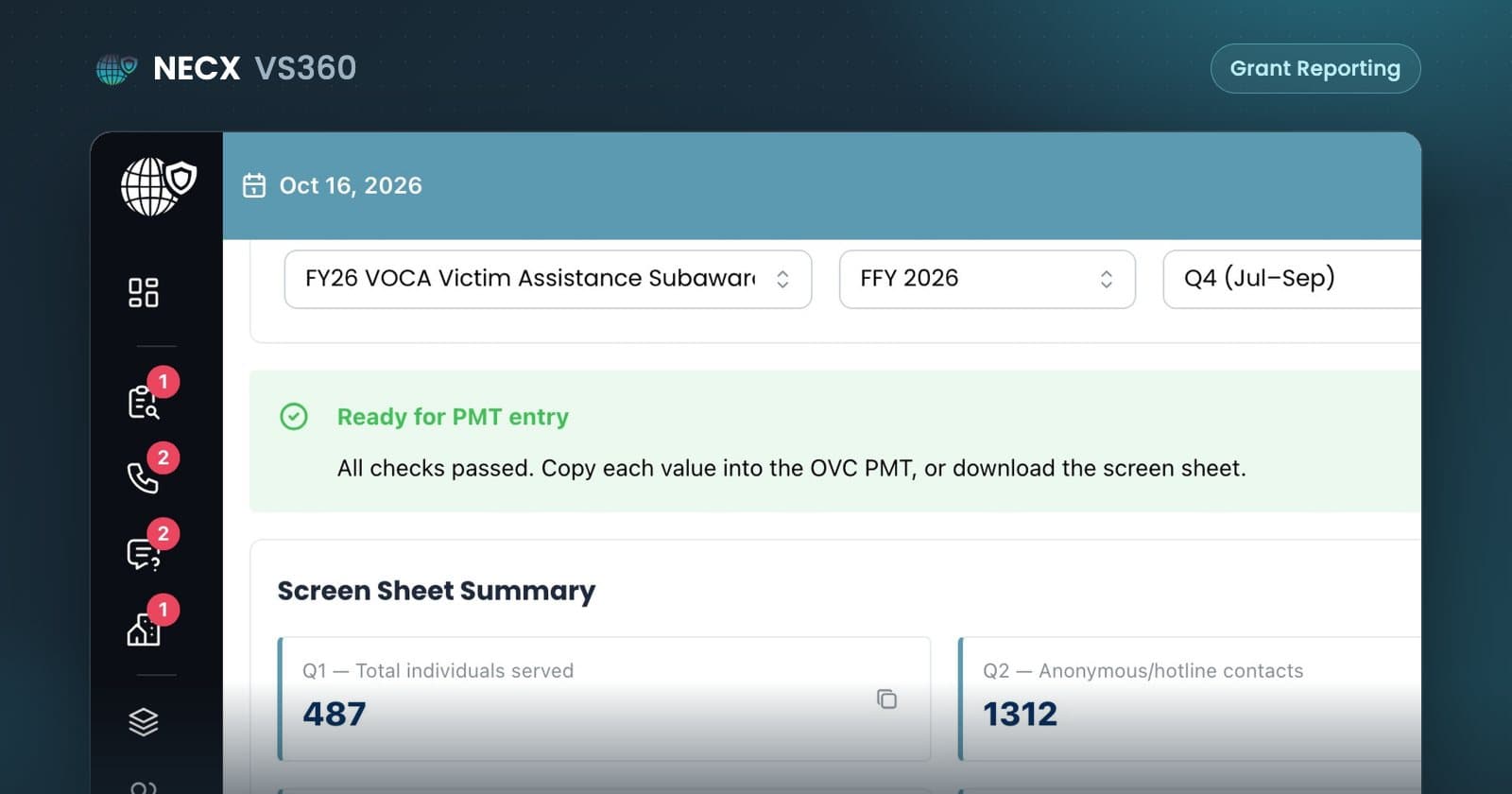
- Produce a screen sheet that mirrors the PMT layout so whoever submits can enter values field by field.
- Have a second person review and sign off, then mark the reporting period finalized so it can't drift.
- Keep the exported PDF with your grant file for monitoring visits.
How NECX VS360 handles VOCA PMT
VS360 was built so that reports build themselves as staff work cases. For VOCA agencies, that means:
- VOCA service events on every case. Advocates log services by VOCA category as they deliver them, tied to the client's single record and the grant that funds the work.
- Quarterly preview and validator. A validation engine flags gaps and inconsistencies before you submit. Reporting periods move from draft to validated to finalized.
- Screen sheet, PMT import row and PDF. The output mirrors what the PMT asks for, so submission is copy-and-confirm.
- Staff time by funding source. Hours roll up by grant, which helps with match and allocation questions.
If your team spends more than a day per quarter assembling PMT numbers, read our checklist for choosing victim services case management software. You can also book a VS360 demo to see the VOCA workflow with fictional data.
Further reading
- VOCA grants explained: where the funding comes from and what it requires.
- Office for Victims of Crime (OVC): official PMT resources, question sets and training.
- HUD comparable databases, APR and CAPER for victim service providers: if you also receive CoC or ESG funding.
Frequently asked questions
How often do VOCA subgrantees report in the PMT?
Quarterly, aligned to the federal fiscal year (October–September). Your state administering agency may also set an earlier internal deadline than OVC's and may collect additional narrative or annual questions.
What are the VOCA service categories?
PMT groups direct services into five areas: information and referral; personal advocacy and accompaniment; emotional support or safety services; shelter and housing services; and criminal or civil justice system assistance. Each contains specific service types.
What is the difference between individuals served and new individuals?
Individuals served counts every unique person who received VOCA-funded services during the quarter. New individuals counts only people served for the first time in the current federal fiscal year, so the same person is never 'new' twice in one year.
Can we report demographics a client didn't share?
No. If a survivor declined or the question wasn't asked, report it in the not-reported or not-tracked category your PMT form provides. Never infer race, gender or age.
Can software submit the PMT report for us?
Agencies still enter or upload data into the PMT themselves. Good case management software prepares the numbers, validates them and produces a screen sheet you can copy from, so submission takes minutes rather than days.
Written by
Victim services & grant compliance specialists
The NECX team builds VS360 alongside victim service agencies, DV/SA programs, shelters and hotlines. We write about the reporting, confidentiality and operational problems we help agencies solve every week.
Keep reading
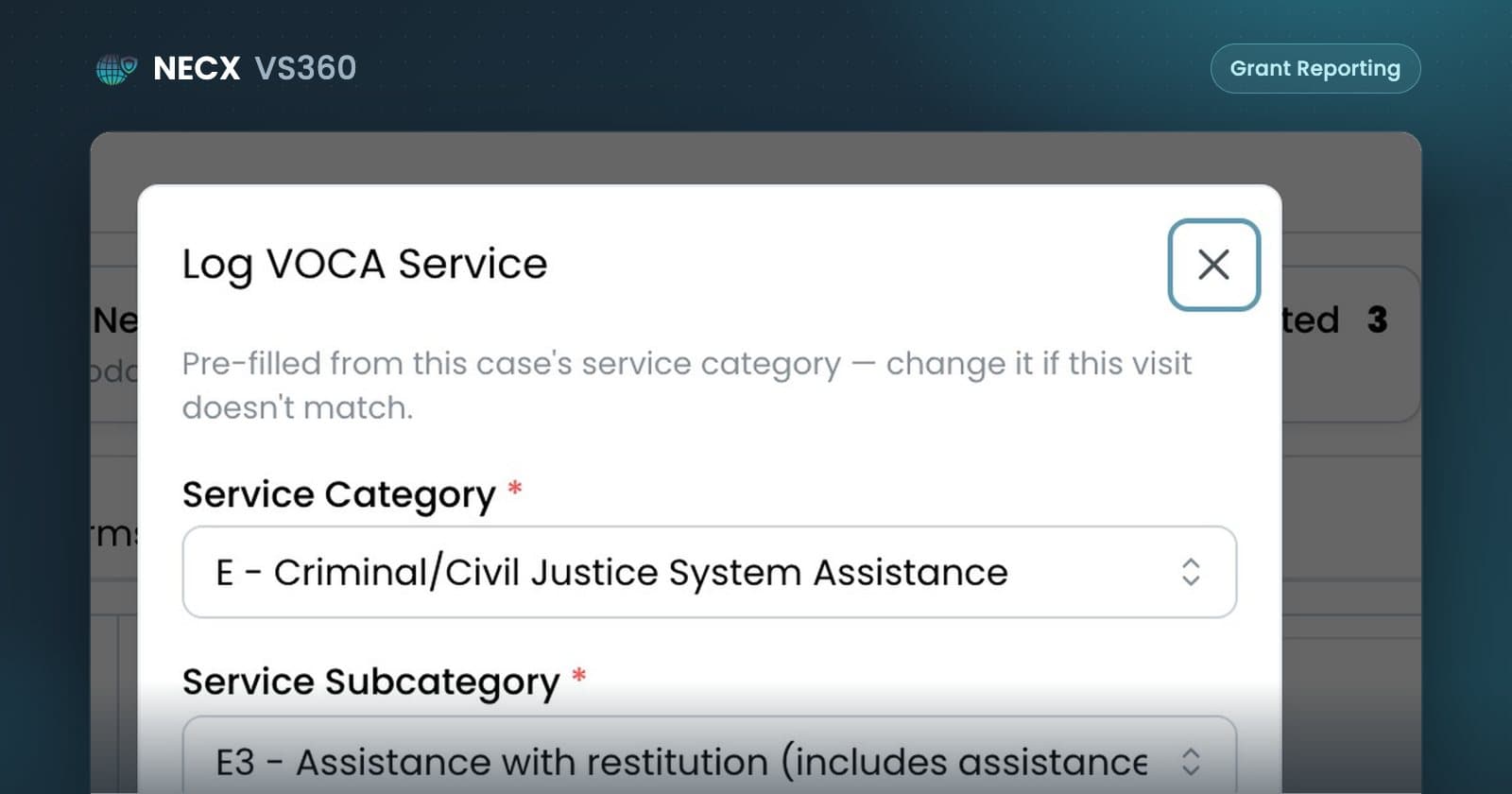
VOCA Grants Explained: How Victim Assistance Funding Works and What It Requires
Where VOCA money comes from, how it reaches local programs, what it pays for, and the reporting and confidentiality rules every VOCA subrecipient has to meet.
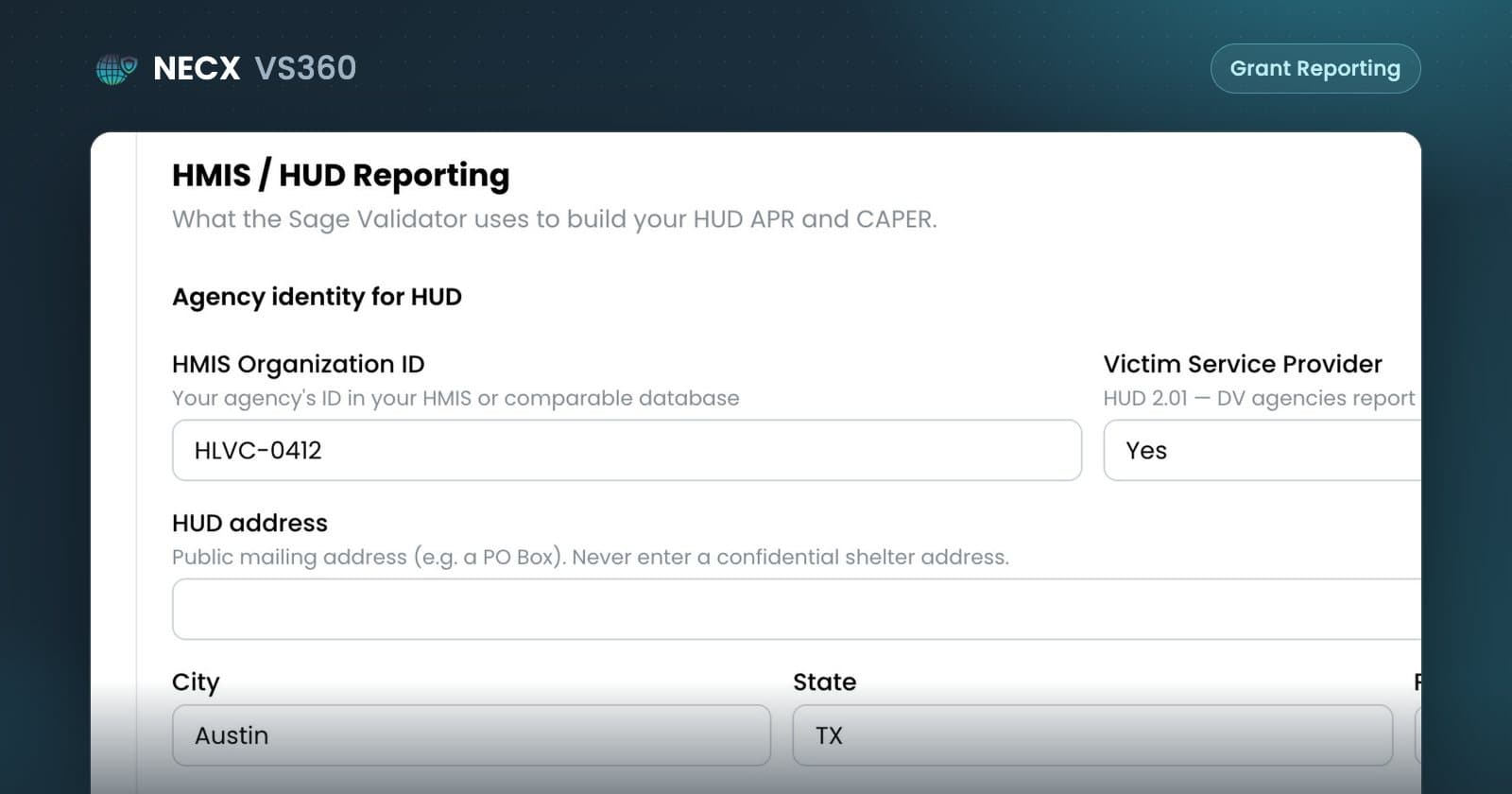
What Is HMIS? The Homeless Management Information System, Explained
A plain-language guide to HMIS: who has to use it, what data goes in, which HUD reports come out, and why domestic violence programs use a comparable database instead.
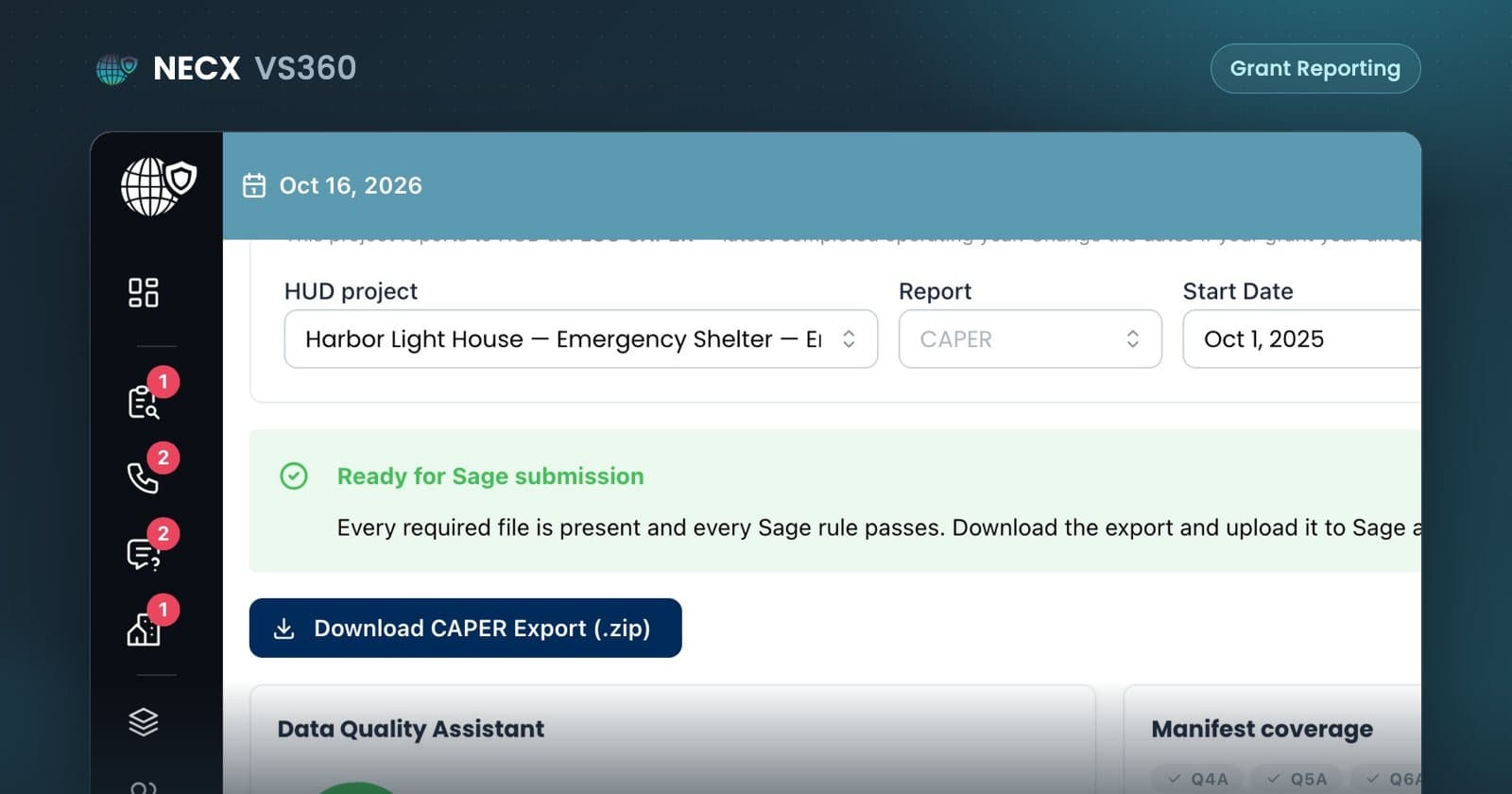
HUD Comparable Databases Explained: CoC APR and ESG CAPER for Victim Service Providers
Why domestic violence and sexual assault programs can't use HMIS, what a HUD comparable database must do, and how to produce a CoC APR or ESG CAPER that passes in Sage.