
VOCA Grants Explained: How Victim Assistance Funding Works and What It Requires
Where VOCA money comes from, how it reaches local programs, what it pays for, and the reporting and confidentiality rules every VOCA subrecipient has to meet.
Key takeaways
- VOCA grants come from the Crime Victims Fund, which is financed by criminal fines, penalties and forfeitures rather than tax dollars.
- The Office for Victims of Crime awards VOCA victim assistance formula grants to a state administering agency, which subgrants the money to local programs.
- States must set aside VOCA assistance funds for victims of domestic violence, sexual assault and child abuse, and for previously underserved victims.
- VOCA subrecipients report performance data to OVC every quarter through the Performance Measurement Tool (PMT) and must protect victim confidentiality.
On this page
- Where does VOCA funding come from?
- How does a VOCA grant reach a local program?
- What do VOCA victim assistance grants fund?
- What does a VOCA grant require from you?
- Quarterly performance reporting
- Confidentiality
- Match, budgets and documentation
- Common VOCA compliance pitfalls
- How NECX VS360 supports VOCA programs
- Further reading
A VOCA grant is federal funding from the Victims of Crime Act of 1984. It is paid from the Crime Victims Fund and passed through each state to the local programs that serve crime victims. For many domestic violence programs, sexual assault centers, child advocacy centers and prosecutor-based victim-witness offices, VOCA is one of their largest funding sources.
This guide explains how the money flows, what it pays for, and what it asks of the programs that receive it.
Where does VOCA funding come from?
The Crime Victims Fund is financed by people convicted of federal crimes, through fines, penalty assessments, forfeited bail bonds and similar collections. It is not general tax revenue.
That design has a practical consequence: VOCA funding rises and falls with deposits, and Congress sets an annual cap on how much can be released. Agencies that depend on VOCA have felt those swings, which is one reason funders now expect efficient, well-documented programs.
How does a VOCA grant reach a local program?
- Congress sets the annual cap on Crime Victims Fund spending.
- The Office for Victims of Crime (OVC), part of the U.S. Department of Justice, awards formula grants to each state.
- The state administering agency (SAA) runs a competition and subgrants the funds.
- Local subrecipients, which are nonprofit and public agencies, deliver the services and report back.
So when someone says "our VOCA grant", they almost always mean a subaward from their state, with the state's own application, budget rules and deadlines.
What do VOCA victim assistance grants fund?
VOCA assistance pays for direct services to crime victims, for example:
- Crisis intervention and hotline counseling
- Safety planning and emotional support
- Personal advocacy and accompaniment to medical, legal and court appointments
- Emergency shelter and relocation assistance
- Help with the criminal or civil justice process, including protection orders
- Information and referral to other services
States must also set aside part of their award for priority populations: victims of domestic violence, sexual assault and child abuse, plus previously underserved victims, as each state defines them.
What does a VOCA grant require from you?
Quarterly performance reporting
Every subrecipient reports to OVC through the Performance Measurement Tool (PMT), usually quarterly, on the federal fiscal year. The report covers who you served, their demographics, the types of victimization, and the services you provided in each VOCA service category.
This is where most of the administrative burden sits. Our VOCA PMT reporting guide walks through the counting rules that trip agencies up.
Confidentiality
VOCA subrecipients must protect the confidentiality of victims' personally identifying information. In practice, sharing information with partner agencies requires the victim's informed, written, time-limited consent. See consent-based referrals.
Match, budgets and documentation
- Match. Subawards have traditionally required a match, but waivers became available after the VOCA Fix Act of 2021. Your SAA's current policy is what counts.
- Allowable costs. Spending must fit federal VOCA rules and your state's narrower policies.
- Time and effort. Staff paid from VOCA need documentation of the time spent on VOCA-funded work. Agencies with several funders track hours by funding source.
Common VOCA compliance pitfalls
- Counting cases instead of people in the PMT, which inflates "individuals served".
- Reconstructing a quarter from notes instead of logging each service when it happens.
- No time-and-effort trail for staff split across VOCA, VAWA, FVPSA and local funds.
- Informal information sharing with partners, without documented consent.
How NECX VS360 supports VOCA programs
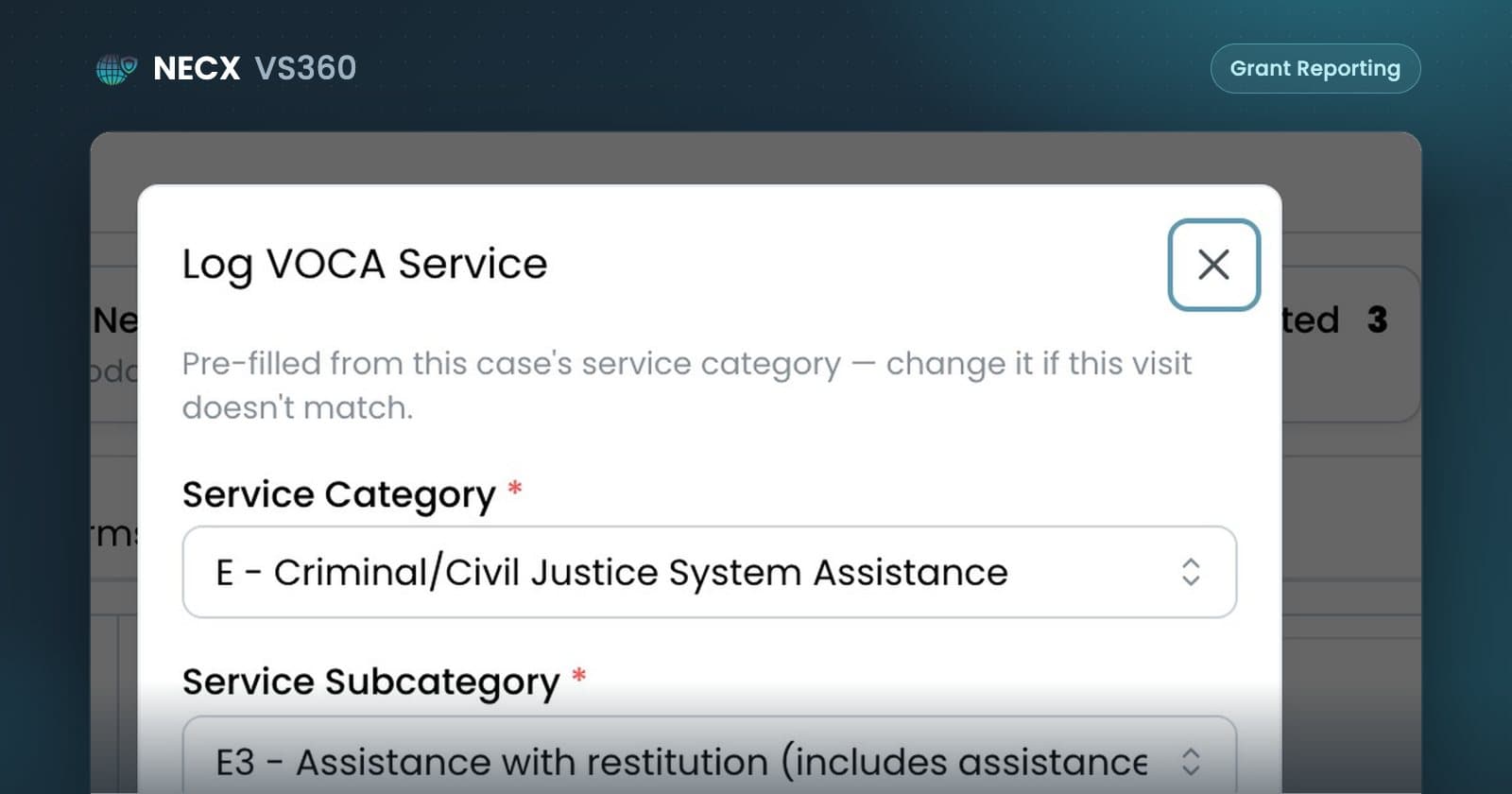
- VOCA service events on every case, logged by category as services are delivered.
- A quarterly PMT preview and validator, plus a screen sheet, PMT import row and PDF.
- Staff time by funding source, with a header timer and a grant picker.
- Consent-based referrals that send only what the client agrees to share.
Comparing systems? Start with our case management software checklist.
Further reading
- Office for Victims of Crime: VOCA program guidance, the PMT and state administering agency contacts.
- Glossary: VOCA, OVC PMT
Frequently asked questions
What is a VOCA grant?
A VOCA grant is federal funding authorized by the Victims of Crime Act of 1984 and paid from the Crime Victims Fund. Victim assistance grants pay for direct services to crime victims, such as crisis intervention, advocacy, counseling and emergency shelter.
Where does VOCA money come from?
The Crime Victims Fund is financed by fines, penalty assessments, forfeited bail bonds and similar collections from people convicted of federal crimes, not by general tax revenue. Because deposits vary year to year, VOCA funding levels change too.
Who can receive VOCA victim assistance funds?
Public and nonprofit organizations that provide direct services to crime victims can apply as subrecipients through their state administering agency. Each state runs its own competition, timelines and requirements.
Is there a match requirement for VOCA?
VOCA assistance subawards have traditionally required a match, but match waivers became available under the VOCA Fix to Sustain the Crime Victims Fund Act of 2021. Whether a match applies to you depends on your state administering agency's current policy.
What reporting does a VOCA grant require?
Subrecipients report performance data to OVC quarterly through the Performance Measurement Tool, plus whatever financial and narrative reports their state requires.
Can VOCA funds pay for case management software?
Many states allow VOCA funds to cover technology that directly supports services to victims, including case management systems. Allowability depends on federal rules and your state's policies, so confirm with your state administering agency before budgeting it.
Written by
Victim services & grant compliance specialists
The NECX team builds VS360 alongside victim service agencies, DV/SA programs, shelters and hotlines. We write about the reporting, confidentiality and operational problems we help agencies solve every week.
Keep reading
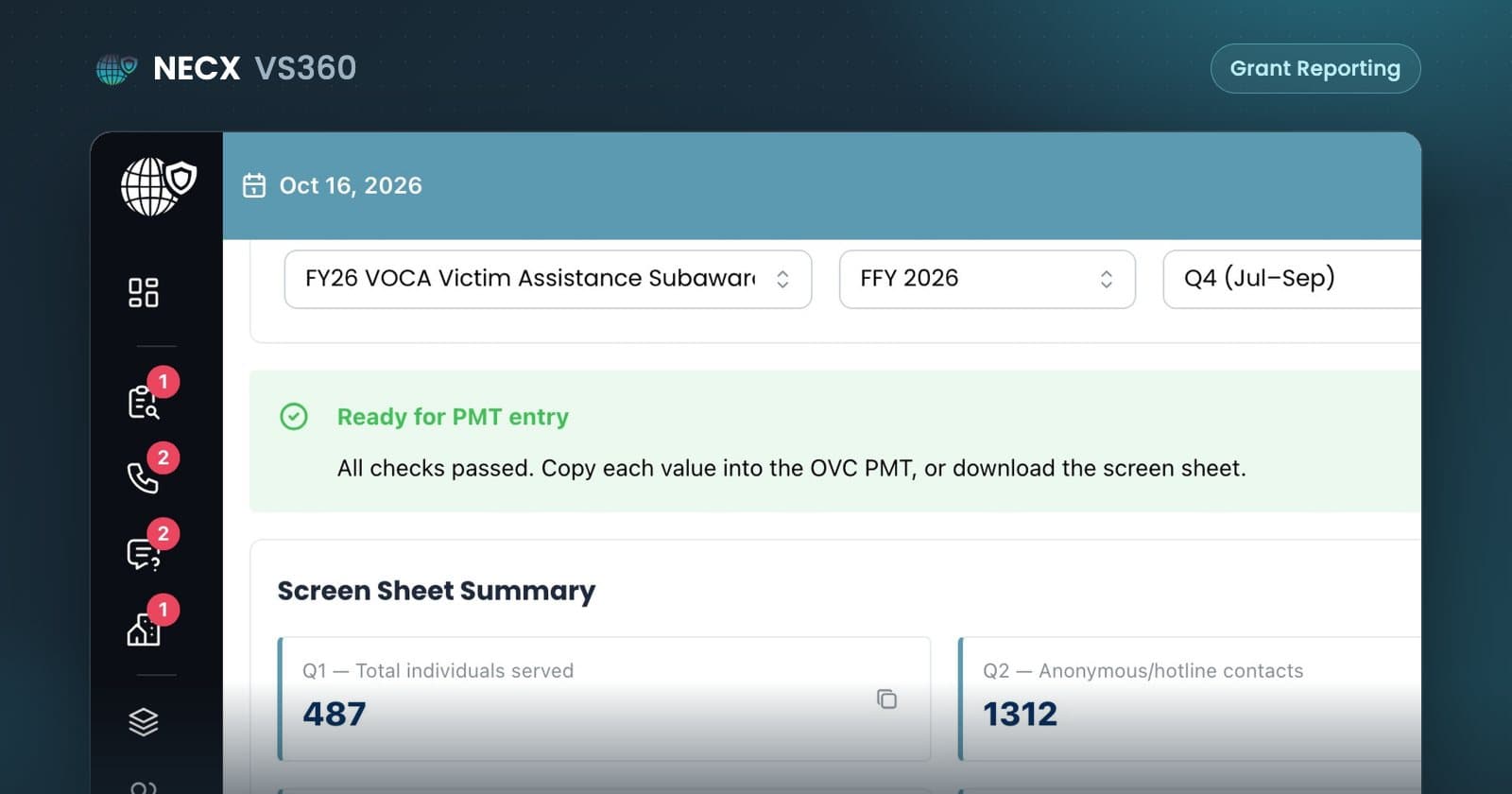
VOCA PMT Reporting: A Practical Quarterly Guide for Victim Service Providers
What VOCA subgrantees report in OVC's Performance Measurement Tool each quarter, the counting mistakes that trigger corrections, and a workflow that keeps the numbers ready before the deadline.
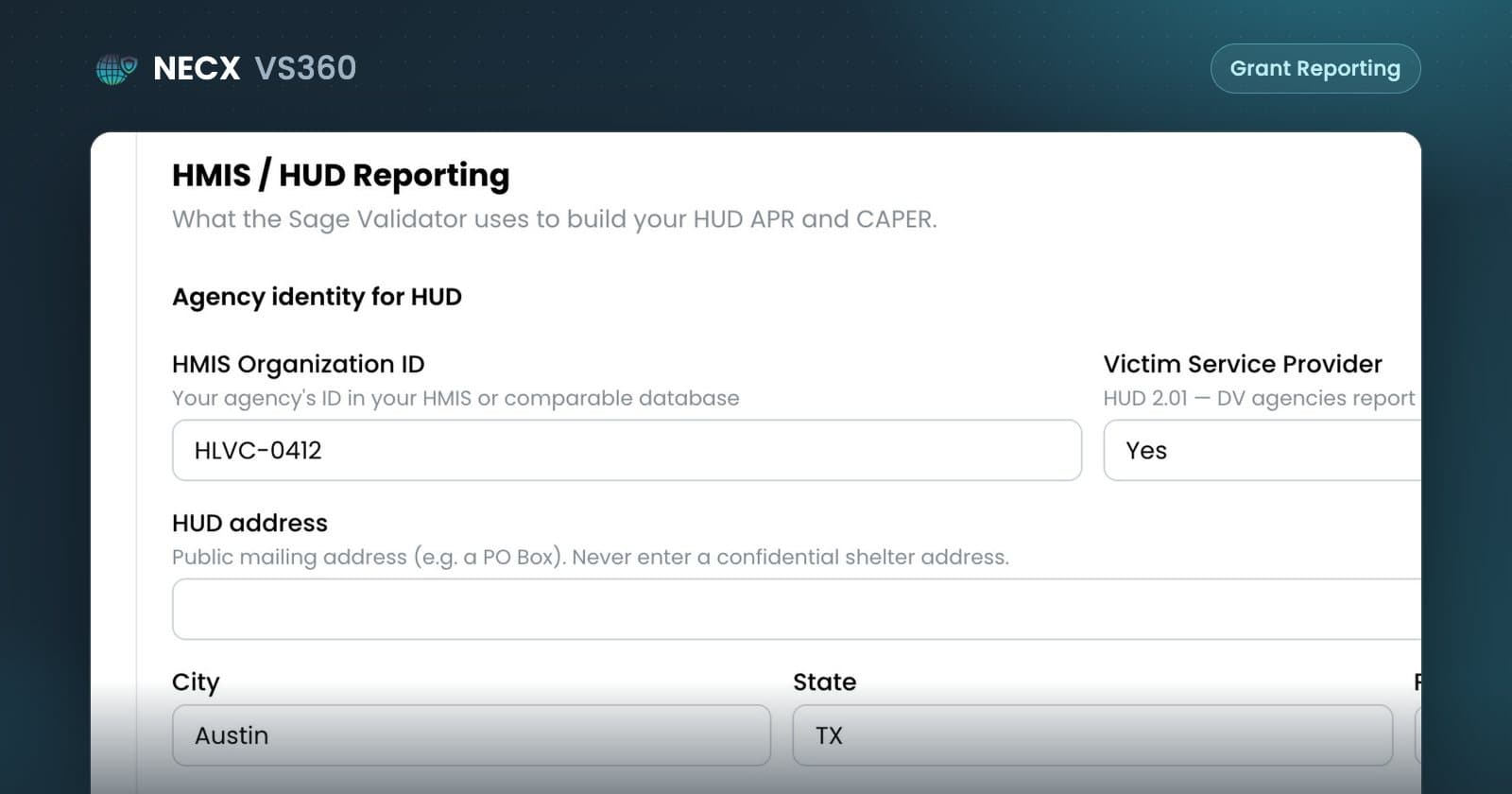
What Is HMIS? The Homeless Management Information System, Explained
A plain-language guide to HMIS: who has to use it, what data goes in, which HUD reports come out, and why domestic violence programs use a comparable database instead.
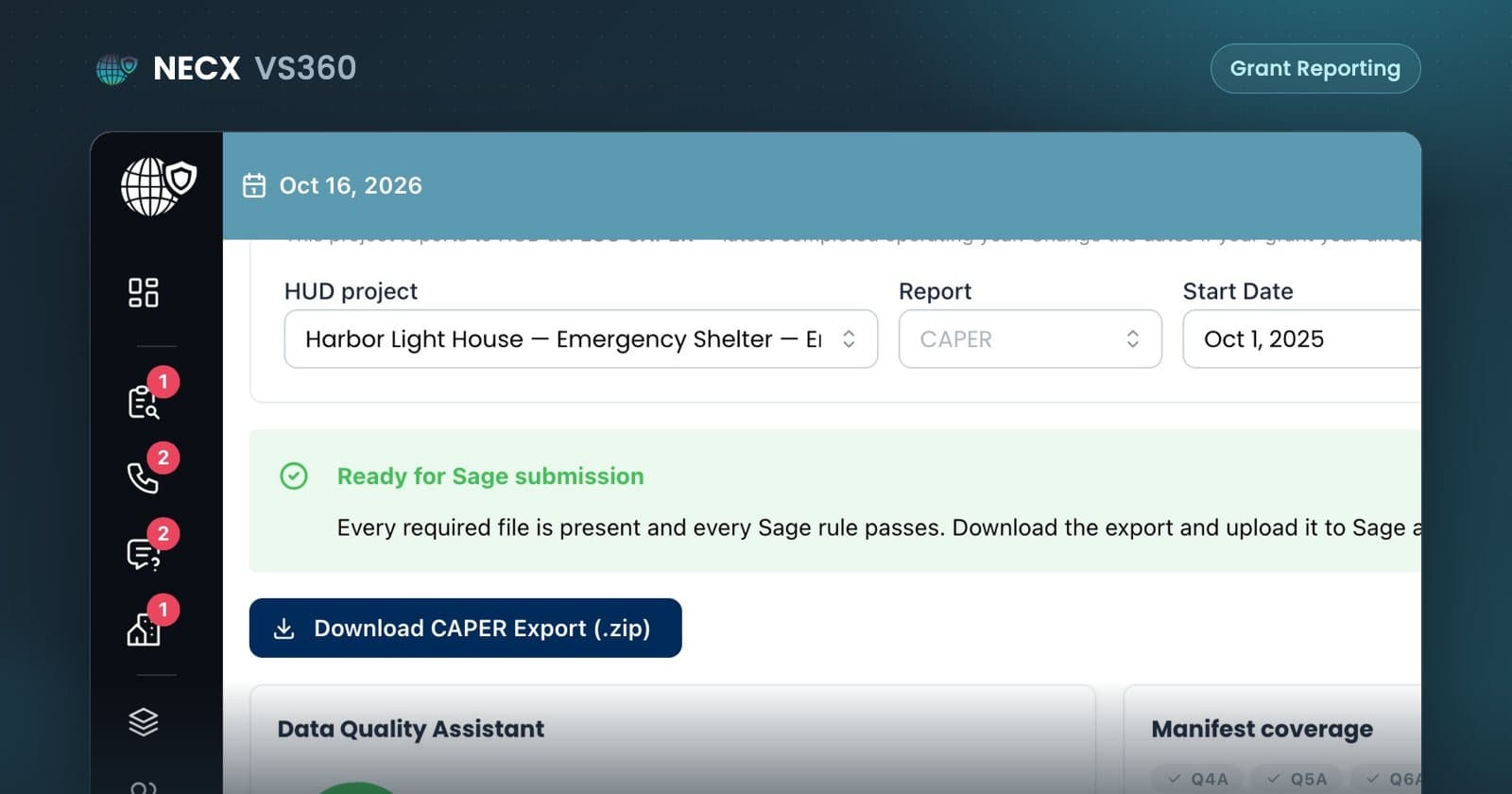
HUD Comparable Databases Explained: CoC APR and ESG CAPER for Victim Service Providers
Why domestic violence and sexual assault programs can't use HMIS, what a HUD comparable database must do, and how to produce a CoC APR or ESG CAPER that passes in Sage.